High-Visibility Uniforms: Safety and Standards in the Industry
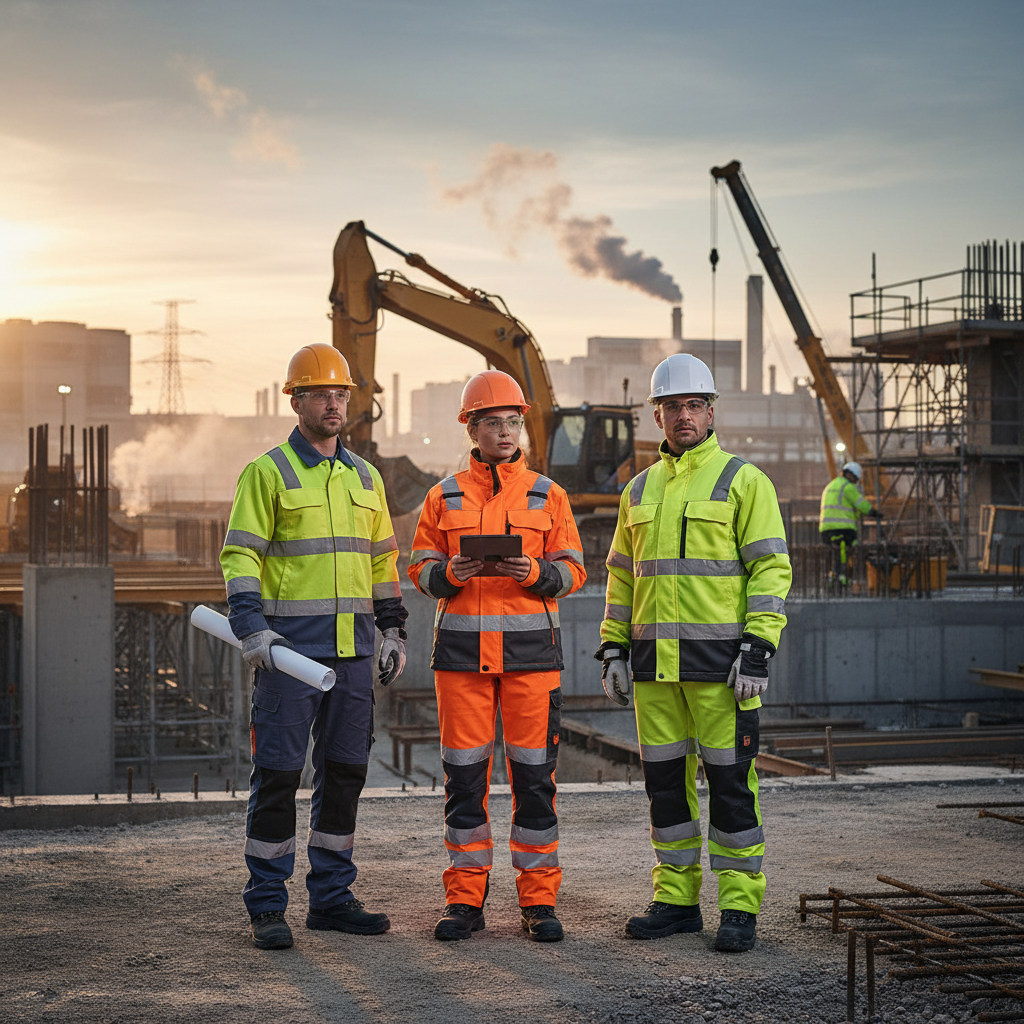
Table of Contents
- Introduction: Visibility as a Pillar of Industrial Safety
- The Science of Visibility: Fluorescence vs. Retroreflection
- EN ISO 20471 Standard: The Gold Standard in Europe 3.1. Class 1: Low Risk 3.2. Class 2: Medium Risk 3.3. Class 3: High Risk
- Essential Equipment: Detailed Product Analysis 4.1. Weather Protection: The Importance of the Parka 4.2. Versatility and Lightness: The Reflective Vest 4.3. Lower Body Protection: High-Visibility Trousers
- Safety Colours: Yellow vs. Orange
- Critical Application Sectors
- Textile Technology and Comfort in Prolonged Use
- PPE Maintenance: How to Wash without Losing Protection
- Personalisation and Branding in Safety Clothing
- Sustainability in PPE and the Future of Protection
- Conclusion
1. Introduction: Visibility as a Pillar of Industrial Safety
In the vast and complex ecosystem of civil construction, heavy industry, and logistics, a second of distraction can result in irreversible consequences. The constant noise of heavy machinery, adverse weather conditions, and the perpetual movement of vehicles create an environment where "being seen" is synonymous with "staying alive." This is where high-visibility uniforms cease to be mere clothing and become vital Personal Protective Equipment (PPE).
It's not just about fulfilling a legal formality or avoiding fines. The correct implementation of high-visibility clothing is an active accident prevention strategy. Global statistics consistently indicate that a significant percentage of accidents on site involve workers being run over by mobile equipment, often because the operator failed to see their colleague in time.
In this in-depth article, we will explore the technology, rigorous standards, and best practices for selecting high-visibility equipment, ensuring that your team not only complies with the law but operates with the highest possible level of safety.
For a more comprehensive view of the workwear ecosystem, we recommend reading our Complete Guide to Professional Uniforms in Portugal.
2. The Science of Visibility: Fluorescence vs. Retroreflection
To understand the effectiveness of these uniforms, it's necessary to dissect the physics behind the materials used. An effective high-visibility garment combines two distinct optical mechanisms that work under opposing lighting conditions:
-
Fluorescent Material (Daylight Visibility): This is the vibrantly coloured fabric (usually yellow, orange, or reddish-orange). Fluorescence works by absorbing invisible ultraviolet (UV) light from the sun and re-emitting it as visible light. This makes the garment appear to "glow" during the day, especially in diffuse light conditions, such as at dawn, dusk, or on cloudy days. The contrast created against grey (concrete), brown (earth), or green (vegetation) environments ensures immediate detection.
-
Retroreflective Material (Night-time Visibility): These are the well-known grey or silver strips. While a mirror reflects light at an opposite angle (specular reflection), retroreflective material uses glass microspheres or prisms to return light directly to its source (like car headlights). At night, without UV light to activate fluorescence, these strips are the only guarantee that a worker will be seen by a driver or machine operator.
The combination of these two materials is what defines compliance with modern safety standards, something we explore in detail in our article on Workwear and PPE: Safety Standards.
3. EN ISO 20471 Standard: The Gold Standard in Europe
The old EN 471 standard has been replaced by EN ISO 20471, which is currently the mandatory international reference for high-visibility clothing. This standard doesn't just suggest the use of bright colours; it mathematically dictates the minimum area of fluorescent and reflective material visible on the worker's body.
The standard divides clothing into three classes, based on the risk level of the work area:
3.1. Class 1: Low Risk
Intended for situations where the risk of collision is reduced and vehicles travel at low speeds (less than 30 km/h).
- Requirement: Minimum of 0.14 m² of fluorescent fabric and 0.10 m² of reflective tape.
- Examples: Car park attendants, warehouse workers with exclusive forklift traffic on defined routes. Often, trousers with small reflective strips or a simple t-shirt can fit here, although they are rarely sufficient for heavy civil construction.
3.2. Class 2: Medium Risk
Mandatory for work near roads where traffic travels up to 60 km/h, or on construction sites where visibility may be sporadically obstructed.
- Requirement: Minimum of 0.50 m² of fluorescent fabric and 0.13 m² of reflective tape.
- Examples: Refuse collectors, urban construction workers, delivery drivers.
An excellent example of a Class 2 garment (or one that contributes to it in conjunction with other garments) is the basic safety vest, which covers the torso and ensures 360-degree visibility.
 View Product: High Visibility Safety Vest
3.3. Class 3: High Risk
This is the maximum protection. It is mandatory for those working on motorways, airports, or near traffic above 60 km/h. The user must be visible from any angle, and the human silhouette must be unmistakable.
- Requirement: Minimum of 0.80 m² of fluorescent fabric and 0.20 m² of reflective tape.
- How to achieve: Generally requires a garment that covers the torso and has long sleeves (like a parka or jacket) OR the combined use of two garments (Vest + Trousers).
To ensure this total protection, especially in adverse climates, the use of complete sets is essential. For more details on head-to-toe protection, consult our footwear collection in the article Professional Footwear: Safety and Comfort Guide.
4. Essential Equipment: Detailed Product Analysis
Selecting the correct PPE involves balancing safety standards with comfort and functionality. Below, we analyse three fundamental pieces from the RAG Tailor's catalogue that cover different spectrums of need.
4.1. Weather Protection: The Importance of the Parka
In winter, visibility drastically decreases due to rain, fog, and shorter days. The worker faces a dual risk: cold (hypothermia/discomfort) and invisibility.
The High Visibility Safety Parka is a Class 3 solution that addresses both problems.
- Waterproof: Essential for keeping the worker dry. A wet worker loses body heat 25 times faster.
- Maximum Visibility: Long sleeves with reflective strips ensure that even if the worker is signalling with their arms, the movement is captured by drivers.
- Thermal Insulation: Allows for long shifts in outdoor environments without loss of motor dexterity.
 View Product: High Visibility Safety Parka
4.2. Versatility and Lightness: The Reflective Vest
The vest is perhaps the most omnipresent PPE garment in the world. Its greatest advantage is its adaptability. It can be worn over a t-shirt in summer or over a (non-reflective) fleece jacket in autumn, immediately providing a layer of safety.
- Ease of Use: Velcro or zipper fasteners allow for quick donning and doffing.
- Breathability: The sleeveless cut prevents overheating during intense physical work.
- Cost-Effectiveness: Allows large teams or site visitors to be equipped with controlled investment.
However, it is crucial to remember that in Class 3 situations, the vest alone may not be sufficient and should be complemented.
4.3. Lower Body Protection: High-Visibility Trousers
Often overlooked, high-visibility trousers are fundamental for defining the human silhouette. When a driver only sees a vest floating in the darkness, depth perception can be affected. By seeing the movement of legs with reflective strips (the so-called "biomotion"), the brain instantly recognises a human in motion.
High-Visibility Safety Trousers offer:
- Durability: Knee reinforcements and abrasion-resistant fabrics, vital for construction.
- Functionality: Pockets for tools and ergonomic design.
- Class Complement: Combined with a vest or jacket, they often elevate the ensemble to Class 3.
 View Product: High Visibility Safety Trousers
This integration of garments is part of a larger protection strategy that can be explored in our complete PPE collection.
 View Collection: Protective Clothing and PPE
5. Safety Colours: Yellow vs. Orange
A common question among purchasing managers is: "What is the correct colour?" The ISO 20471 standard approves three colours: Fluorescent Yellow, Fluorescent Orange-Red, and Fluorescent Red.
- Fluorescent Yellow: It is the brightest of the three colours. It offers the greatest contrast in urban environments and against black asphalt. It is the preferred choice for general construction and warehousing work.
- Fluorescent Orange: Offers superior contrast in snowy environments (where yellow may lose prominence) or in areas with dense vegetation ("green background").
- Railway Industry (RIS-3279-TOM): In the railway sector, specifically in the UK and adopted by many international companies, orange is the only permitted colour to avoid confusion with yellow train signals.
The choice should be based on a risk assessment of the background environment where the task will be performed.
6. Critical Application Sectors
While construction is the obvious example, high-visibility uniforms are used across various sectors:
- Logistics and Warehousing: Forklift drivers have significant blind spots. Ground personnel need to be seen instantly.
- Emergency and Rescue Services: Quick visual differentiation between medical teams, firefighters, and police is crucial in a chaotic scenario.
- Waste Management and Urban Cleaning: These professionals often work on public roads, frequently in the early morning hours. See our article on Uniforms for Cleaning and General Services.
- Airports: The airside environment is one of the most dangerous in the world, requiring strict compliance with Class 3 standards.
7. Textile Technology and Comfort in Prolonged Use
In the past, wearing a reflective vest meant donning a plastic cape that made the worker sweat excessively. Today, technology has evolved.
- Breathable Fabrics: The use of technical polyester meshes allows sweat to evaporate, keeping the body dry.
- Elasticity: The incorporation of elastane allows garments to follow body movement, essential for those climbing scaffolding or handling loads.
- Softshell and Technical Fabrics: For managers and engineers, Softshell material offers high visibility with a more professional and elegant finish, without sacrificing safety. Corporate uniforms can and should be safe, as discussed in Corporate Uniforms: Professional Image.
8. PPE Maintenance: How to Wash without Losing Protection
A dirty high-visibility uniform ceases to be high-visibility. Dust, mud, and grease cover the microprisms of the reflective strips and dull the fluorescence of the fabric. However, incorrect washing can destroy the PPE.
Golden Rules for Maintenance:
- Do not use fabric softener: Fabric softener creates a film on the fibres that nullifies the retroreflective capacity of the strips.
- Controlled Temperature: Wash generally at 40°C (maximum 60°C, depending on the label). Excessive heat damages the tapes.
- Avoid Bleach: Chlorine destroys fluorescent pigmentation, turning bright yellow into pale yellow with no UV protection capability.
- Respect Cycles: Most garments have a certified maximum number of washes (usually between 25 to 50 cycles). After this limit, the garment must be replaced, as reflectivity no longer guarantees compliance with ISO 20471.
9. Personalisation and Branding in Safety Clothing
The customisation of high-visibility uniforms is an excellent marketing and authority tool on site, but it requires extra care.
When applying a logo (whether by embroidery or printing), you are covering fluorescent or reflective area. If the logo is too large, the garment may lose its Class certification (e.g., drop from Class 3 to Class 2) because the minimum area of visible material has been reduced.
- Solution: Apply logos in designated areas where the impact on safety is nil, or use logos in reflective material.
- To learn more about application methods, see our comparison: Customised Uniforms: Embroidery or Printing?.
10. Sustainability in PPE and the Future of Protection
The textile sector faces increasing pressure for sustainability. In PPE, the challenge is greater: how to recycle fabrics that are complex mixtures of polyester, chemical treatments, and glass (in the tapes)?
The trend points towards the use of Recycled Polyester (rPET) from plastic bottles, maintaining safety certification. Furthermore, durability is the primary form of sustainability. A high-quality parka that lasts three winters is more environmentally friendly than a cheap one that lasts three months.
For those interested in this topic, our article on Sustainable Uniforms: Ecological Fabrics delves into "green" options in professional clothing.
11. Conclusion
Investing in quality high-visibility uniforms is not an expense; it's operational life insurance. By choosing certified products like the Parka, Vest, or Trousers from RAG Tailor's, you are ensuring that your team returns home safely every day.
Visibility is the first line of defence against danger. Don't let your safety remain in the shadows. Equip yourself with the correct standard, choose comfort to promote constant use, and maintain your equipment in perfect condition.
Explore our complete protection collection and find the ideal solution for your industry.