Uniforms for Cleaning and General Services: Practical and Durable
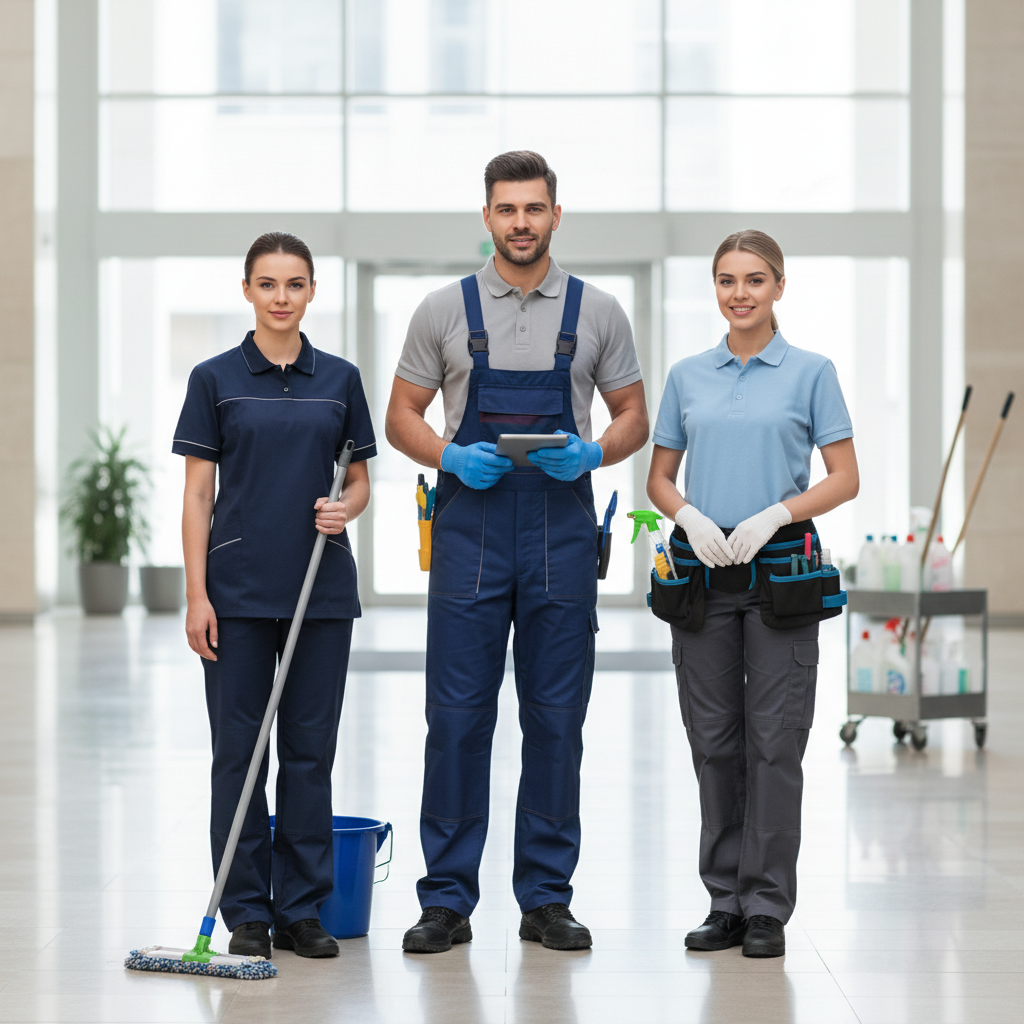
The perception of cleanliness in a place begins long before checking the floor or surfaces; it begins with the appearance of the person performing the service. A well-uniformed team instantly conveys:
- Professionalism and Competence: A neat uniform suggests that the attention to detail applied to clothing will be the same applied to the cleaning task.
- Safety and Trust: In office buildings, hotels, or hospitals, it is crucial for users to be able to immediately identify authorized staff. The uniform acts as a visual identification card.
- Visual Hygiene: Light or vibrant colours, when immaculate, reinforce the message of cleanliness. Conversely, worn-out uniforms can send the wrong message, even if the work is well executed.
For companies providing outsourcing services, uniforms act as a mobile billboard. Each employee is a brand ambassador to the end client. Investing in the visual quality of these garments is, therefore, a direct marketing strategy.
For a more comprehensive view of workwear in Portugal, you can consult our Complete Guide to Professional Uniforms, where we cover the fundamentals of the sector.
2. Ergonomics and Comfort: The Secret to Productivity
The work of cleaning and general services is physically demanding. It involves repetitive movements, crouching, lifting loads, and often walking long distances. A uniform that restricts movement or causes thermal discomfort will inevitably reduce productivity and increase the risk of injuries.
Modern cuts, such as those found in our collection, prioritize:
- Side Openings: In tunics and smocks, these facilitate access to trouser pockets and allow for greater range of motion in the hips.
- Elastic Waists: In trousers, these provide abdominal comfort during bending movements.
- Short or 3/4 Sleeves: These prevent the fabric from getting wet or dirty during surface and dish washing, maintaining hygiene.
Comfort is not a luxury; it is a functional necessity. Comfortable employees work better and with more motivation.
3. Technical Fabrics: Resistance to Washing and Chemicals
Unlike a reception uniform, a cleaning uniform faces daily enemies: bleach, acidic detergents, grease, and industrial washing at high temperatures. The choice of fabric is the determining factor for the longevity of the investment.
- Polycotton: The most popular blend (usually 65% polyester, 35% cotton). Polyester ensures tensile strength, colour retention, and ease of ironing, while cotton offers breathability.
- Microfiber: Extremely lightweight, quick-drying, and often with liquid-repellent properties. It is excellent for warm environments.
- Fabrics with Elastane: For functions requiring a lot of mobility, a small percentage of elastane adds flexibility to the fabric, preventing it from tearing under tension.
Colour fastness is vital. Uniforms that look "washed out" after a few weeks damage the company's image.
4. Types of Cleaning Uniforms: From Apron to Tunic
There is no "one size fits all" for all cleaning functions. The hierarchy and specificity of the task dictate the model:
- Smocks and Tunics: These are the standard choice. They protect the torso and part of the thighs. They can have large front pockets, essential for carrying cloths, gloves, or master keys.
- Trouser and Jacket Sets: Popular in hospital and healthcare settings, offering full protection. Check options in our guide on Healthcare Uniforms.
- Aprons: Essential pieces for extra protection over the base uniform, especially in "wet" tasks or in the pantry.
5. Product Highlight: Versatility and Protection
Two examples from our catalogue perfectly illustrate the union between design and functionality for this sector.
The Wrap Tunic: Protection with Style
The "Wrap" design is phenomenal for adjusting the garment to different body types, ensuring that the uniform always fits well, regardless of the employee's silhouette. This type of apron/tunic offers excellent front and back coverage, allowing total arm freedom.

View Product: Wrap Tunic Apron
Mozambique Smock: Coverage and Professionalism
For those who prefer a more classic solution with greater coverage, the Mozambique Smock is a benchmark. Ideal for cleaning supervisors or for general services in educational and healthcare environments, where the projection of authority and cleanliness is vital. Its cut allows personal clothing to be worn underneath without losing elegance.
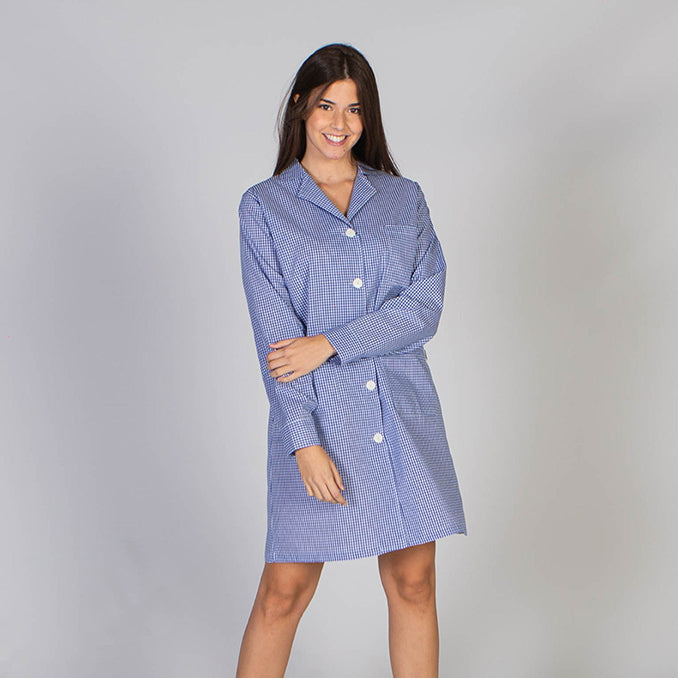
View Product: Mozambique Smock
6. Professional Footwear: The Foundation of Workplace Safety
To talk about cleaning uniforms without mentioning footwear is to ignore the greatest safety risk in this profession: falls and slips. Wet, waxed, or residue-laden floors are constant traps.
Footwear for general services must comply with anti-slip standards (SRC). Furthermore, it must be:
- Waterproof: To prevent water and chemicals from coming into contact with the skin.
- Breathable: To prevent the proliferation of fungi after hours of use.
- Ergonomic: With insoles that absorb impact, protecting joints and the spine.

View Collection: Professional Footwear
For a technical in-depth look, we recommend reading our article: Professional Footwear: Safety and Comfort Guide.
7. Cleaning Uniforms in Hospital and Clinical Environments
Cleaning in healthcare environments (hospitals, clinics, nursing homes) requires a higher level of care. Here, the uniform is also a barrier against cross-contamination.
Fabrics with antibacterial treatments that can withstand washing at 60ºC or more are mandatory. Colour also plays a crucial role in coding areas (e.g., green uniforms for surgical zones, blue for inpatient wards, yellow for isolation), aiding in infection control.
Our collections for healthcare offer these technical characteristics without compromising on comfort.
8. Housekeeping and Hospitality: Elegance in Room Service
In the hotel sector, the Housekeeping department (Executive Housekeepers and Room Attendants) is the heart of the operation. The uniform here must reflect the "soul" of the hotel. A luxury hotel demands uniforms with tailored cuts, noble fabrics, and subtle finishes.
In these scenarios, functionality (discreet pockets, wrinkle-resistant fabrics) must merge with aesthetics. The presentation of the chambermaid is part of the guest experience. Sober colours such as black, grey, navy blue, or burgundy are classics that never fail.
For more details on this specific sector, see our guide: Uniforms for Restaurants and Hotels: Elegance and HACCP.
9. Safety and PPE in Industrial Cleaning
When moving from domestic or office cleaning to industrial or construction cleaning, the risks change. Heavy machinery, forklifts, and corrosive chemicals come into play.
In this context, the uniform becomes a Personal Protective Equipment (PPE). Essential features now include:
- High Visibility: Uniforms with reflective strips so that workers are seen in warehouses or construction sites. Learn more in High Visibility Uniforms for Construction and Industry.
- Acid Resistance: Fabrics treated to repel chemical splashes.
- Thermal Protection: For cleaning in cold storage rooms or outdoors.
Safety should never be compromised. European occupational safety standards require strict compliance for this type of clothing.