Workwear and PPE: Standards and Safety | RAG Tailors
Table of Contents
- Introduction: The New Paradigm of Workplace Safety
- The Role of ACT and Current Legislation
- High Visibility: Much More Than Fluorescent Colours
- Lower Limb Protection: The Evolution of Safety Footwear
- Mechanical and Chemical Risks: Workwear That Saves Lives
- Ergonomics and Design: Comfort as a Safety Factor
- The Intelligent Choice of Materials and Sustainability
- Management and Maintenance of PPE in Companies
- Conclusion: Investing in Safety is Investing in the Future
1. Introduction: The New Paradigm of Workplace Safety
Workplace safety has ceased to be merely a bureaucratic requirement to become a central pillar in the organisational culture of construction and industrial companies. As we advance into the second half of the decade, we observe a radical transformation in how organisations view individual protection. It is no longer just about completing a checklist to avoid fines; it is about ensuring the physical integrity of highly specialised teams in a market where skilled labour is a precious asset.
Workplace accident statistics continue to indicate that most serious accidents could have been avoided, or their consequences drastically minimised, through the correct use of Personal Protective Equipment (PPE) and appropriate workwear. In this context, professional workwear has evolved. Today, technical clothing combines advanced textile engineering with rigorous safety standards, resulting in equipment that protects without compromising mobility.
This in-depth article serves as a definitive guide for managers, safety technicians, and workers who need to understand the nuances of current safety standards, legal obligations, and best practices for selecting protective equipment.
This article is a specialised complement to our Complete Guide to Professional Workwear and Uniforms in Portugal, where we gather the best practices and industry standards.
2. The Role of ACT and Current Legislation
The Authority for Working Conditions (ACT) remains the reference regulatory and supervisory body in Portugal. Its actions have intensified, not only from a punitive perspective but, above all, from an educational and preventive one. However, for construction and industrial companies, ignorance of the law does not serve as justification for non-compliance.
2.1. Employer and Employee Obligations
According to the current legal framework, responsibility for safety is shared, although the burden of provision falls on the employer.
- Free Provision: The employer is obliged to provide the appropriate PPE for the risks of the job, without any cost to the worker.
- Maintenance and Replacement: It is not enough to provide the equipment; it is necessary to ensure that it remains in good working order and hygiene, replacing it whenever necessary.
- Training: Providing a harness or chemical protection suit without explaining how to use it is considered a serious safety failure.
On the other hand, the worker has the duty to use the provided equipment, ensure its conservation, and immediately report any defect or malfunction.
2.2. Risk Assessment as a Starting Point
Before purchasing any item, the company must conduct an exhaustive risk assessment. ACT standards require PPE to be the last line of defence. The hierarchy of risk control dictates that we should try, in the following order:
- Eliminate the risk.
- Substitute the hazardous process.
- Apply engineering controls (collective protections).
- Apply administrative controls (signage, shift rotation).
- Use PPE (when risks cannot be avoided by previous means).
To learn more about how to integrate corporate image with safety, consult our article on Corporate Workwear: Professional Image for Companies, where we explore this balance.
3. High Visibility: Much More Than Fluorescent Colours
In the civil construction, public works, and industrial logistics sectors, the risk of being run over or colliding with mobile machinery is one of the main causes of fatal accidents. This is where the EN ISO 20471 standard comes in, which regulates high-visibility clothing.
It's not just about wearing a yellow vest. The standard defines specific requirements for the area of background material (fluorescent) and retroreflective material (the strips that shine with headlight beams).
3.1. Safety Classes
The standard divides clothing into three classes, depending on the required level of visibility:
- Class 1 (Low Risk): Allows the user to be seen, but is insufficient for work on roads or places with fast-moving machinery. Generally used in private car parks or warehouses with slow traffic.
- Class 2 (Medium Risk): Mandatory for those working near road traffic (speeds up to 60 km/h) or on construction sites. Requires a larger area of fluorescent fabric and reflective tapes.
- Class 3 (High Risk): The maximum level of protection. Essential for motorways, airports, and railways. Covers the torso and, obligatorily, arms or legs with reflective material.
To delve deeper into this specific topic, we recommend reading the dedicated article: High-Visibility Workwear for Construction and Industry.
Below, we present an essential solution that meets the requirements for immediate visual signalling on site:

View Product: High-Visibility Safety Vest
3.2. The Importance of Contrast and Maintenance
A common mistake is to ignore material degradation. Dirt, wear, and successive washes reduce the reflective capacity of the tapes and the luminosity of the fluorescent fabric. A vest soiled with cement or oil ceases to be compliant PPE. Periodic replacement is vital.
4. Lower Limb Protection: The Evolution of Safety Footwear
Footwear is, perhaps, the most critical element of a construction or industrial worker's equipment. Spending 8 to 10 hours on your feet, on uneven surfaces, exposed to nails, heavy objects, and chemicals, requires elite protection. The EN ISO 20345:2022 standard brought important updates that clarify protection levels.
4.1. Understanding the Acronyms (S1P, S3, S7)
The wrong choice of footwear can lead to debilitating injuries.
- SB (Basic Safety): Toecap resistant to 200 Joules.
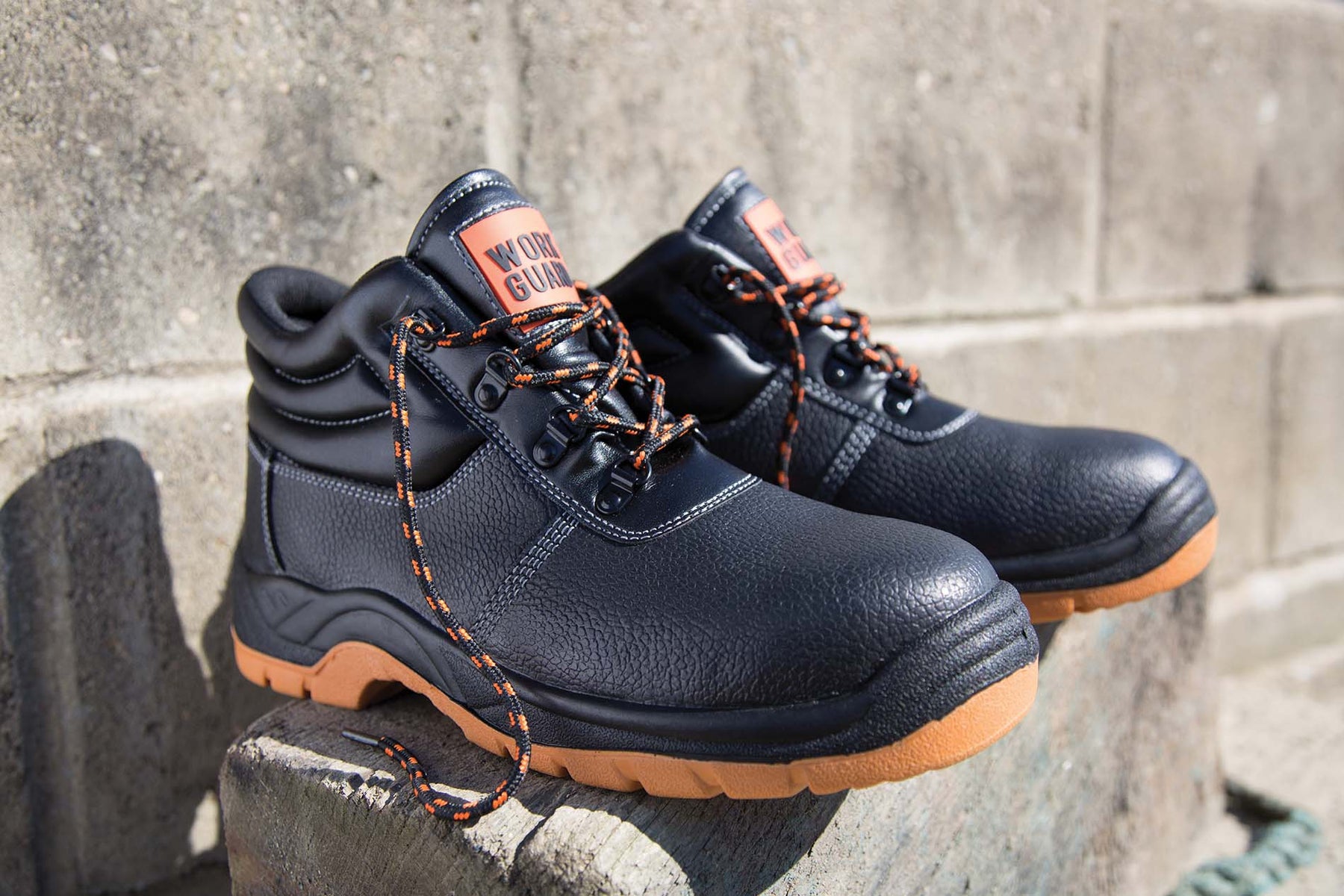
- S1P: Includes toecap, closed heel area, energy absorption in the heel, antistatic properties, and, crucially, a puncture-resistant midsole. Ideal for dry, indoor environments.
- S3: Everything S1P offers, plus water penetration resistance in the upper. It is the standard for "classic" civil construction.
- S7: A new classification from the 2022 standard that guarantees more robust waterproofing (full boot), not just water resistance.
4.2. The Hidden Danger: Slipping
Same-level falls account for a huge percentage of medical leaves. Slip resistance (formerly SRA, SRB, SRC) now has new testing protocols. Dual-density PU (Polyurethane) or Nitrile Rubber soles are essential to ensure grip on floors with oils, water, or debris.
For a complete guide on how to choose the right boots, see our Professional Footwear: Safety and Comfort Guide.
We present the "Defence" model, a robust choice that exemplifies S1P protection with superior comfort:
View Product: Defence Safety Boots
In addition to this model, we offer a wide range of options for different sectors:

5. Mechanical and Chemical Risks: Workwear That Saves Lives
In heavy industry, metalworking, and handling hazardous substances, "normal clothes" are an invitation to disaster. Simple cotton fabrics can absorb corrosive chemicals or tear easily on contact with sharp edges.
5.1. Cut Protection (EN 388)
The EN 388 standard evaluates resistance to mechanical risks: abrasion, blade cut, tear, and puncture. In environments where metal sheets, glass, or cutting tools are handled, clothing must have reinforcements in vital areas (forearms, abdomen, thighs). Fibre technology such as Kevlar or HPPE (High-Performance Polyethylene) allows for light clothing with very high cut resistance.
5.2. Chemical Protection (EN 13034 and EN 14605)
For workers dealing with solvents, acids, or paints, chemical protection is non-negotiable. There are several types:
- Type 3 and 4: Protection against liquid jets and strong sprays (generally full impermeable suits).
- Type 6: Protection against accidental splashes of liquid chemicals (very common in manufacturing industries and laboratories).
It is crucial to verify the permeation time of the fabric against the specific chemical used in the factory. What protects against one acid may be useless against an organic solvent.
For specific cleaning and light chemical handling needs, consult: Workwear for Cleaning and General Services: Practical and Resistant.
You can explore our complete collection of PPE here:

View Product: Protective Clothing and PPE
6. Ergonomics and Design: Comfort as a Safety Factor
There is an old myth that "if it's safe, it's uncomfortable." In 2025, this premise is completely obsolete. Ergonomics is now considered an active safety component. An uncomfortable worker is a distracted worker, and distraction is the antechamber of an accident.
6.1. Freedom of Movement
In construction clothing, the design of the pieces must consider:
- Reinforced seams in tension areas, but strategically placed to avoid skin friction.
- Elastic (Stretch) fabrics incorporated in areas such as the knees and back, allowing squats and lifts without the clothing restricting movement.
- Ventilation: In hot climates or heated industrial environments, thermal stress is a real danger. Workwear with moisture-wicking technologies and ventilation zones in the armpits and back helps regulate body temperature.
6.2. The Weight of the Equipment
Every gram counts. Heavy safety boots increase muscle fatigue at the end of the day, which can lead to trips. The replacement of steel with composites (carbon, fibreglass) in safety toecaps has drastically reduced the weight of footwear without compromising protection against impacts.
If you are looking to combine protection with elegance in less industrial sectors, see: Workwear, Professional Uniforms, and Footwear: Complete Guide.
7. The Intelligent Choice of Materials and Sustainability
Sustainability has definitively entered the agenda of Purchasing and Safety departments. Companies are now looking for PPE that lasts longer (reducing waste) and is produced ethically.
7.1. Recycled Polyester and Organic Cotton
Many modern work uniforms incorporate recycled polyester (from PET bottles) that maintains the durability and abrasion resistance required for industry, but with a much lower carbon footprint.
7.2. Durability is Sustainability
The most ecological workwear is that which does not need to be replaced every three months. Investing in high-grammage fabrics with stain-repellent treatments (water and oil) prolongs the life of the garment, reducing long-term costs and environmental impact.
Learn more about this growing trend in our article: Sustainable Workwear: Ecological and Recycled Fabrics.
8. Management and Maintenance of PPE in Companies
The implementation of an effective workwear and PPE policy does not end with purchase. Equipment lifecycle management is fundamental.
- Regular Inspection: Supervisors must be trained to identify signs of wear and tear on the team's PPE. A cracked sole, a helmet that has suffered an impact, or a faded vest must be taken out of service immediately.
- Correct Sanitisation: Workwear with chemical or flame-retardant protection requires specific washing processes. Domestic washing with aggressive detergents or fabric softeners can destroy the protective properties of the fabric. It is recommended to hire specialised industrial laundries or provide rigorous worker training.
- Storage: PPE must be stored in dry, ventilated places, away from direct sunlight, which can degrade plastics and textile fibres.
When creating customised workwear for your company, remember that placing logos (embroidered or printed) should not perforate waterproof membranes or cover areas of retroreflective material required by standard. Read more about safe customisation in: Custom Workwear: Embroidery or Printing?.
9. Conclusion: Investing in Safety is Investing in the Future
In 2025, workwear and PPE in construction and industry represent the fusion of legal requirements and technological innovation. There are no shortcuts when human life is at stake. ACT standards and European directives provide the roadmap, but it is up to each company to implement a culture where safety is valued above execution speed.
Choosing the right partner for supplying technical workwear is crucial. It requires someone who understands not only textiles, but also standards, risks, and the specific needs of each job. By ensuring that your team is equipped with high-visibility clothing, certified footwear, and protection against specific risks, you are building a solid foundation for productivity and, above all, for ensuring that everyone returns home safely at the end of the day.
Explore our complete range of solutions, from the industrial sector to healthcare, and discover how we can elevate your company's safety standards.