Custom Uniforms: Embroidery or Printing? Technical Guide
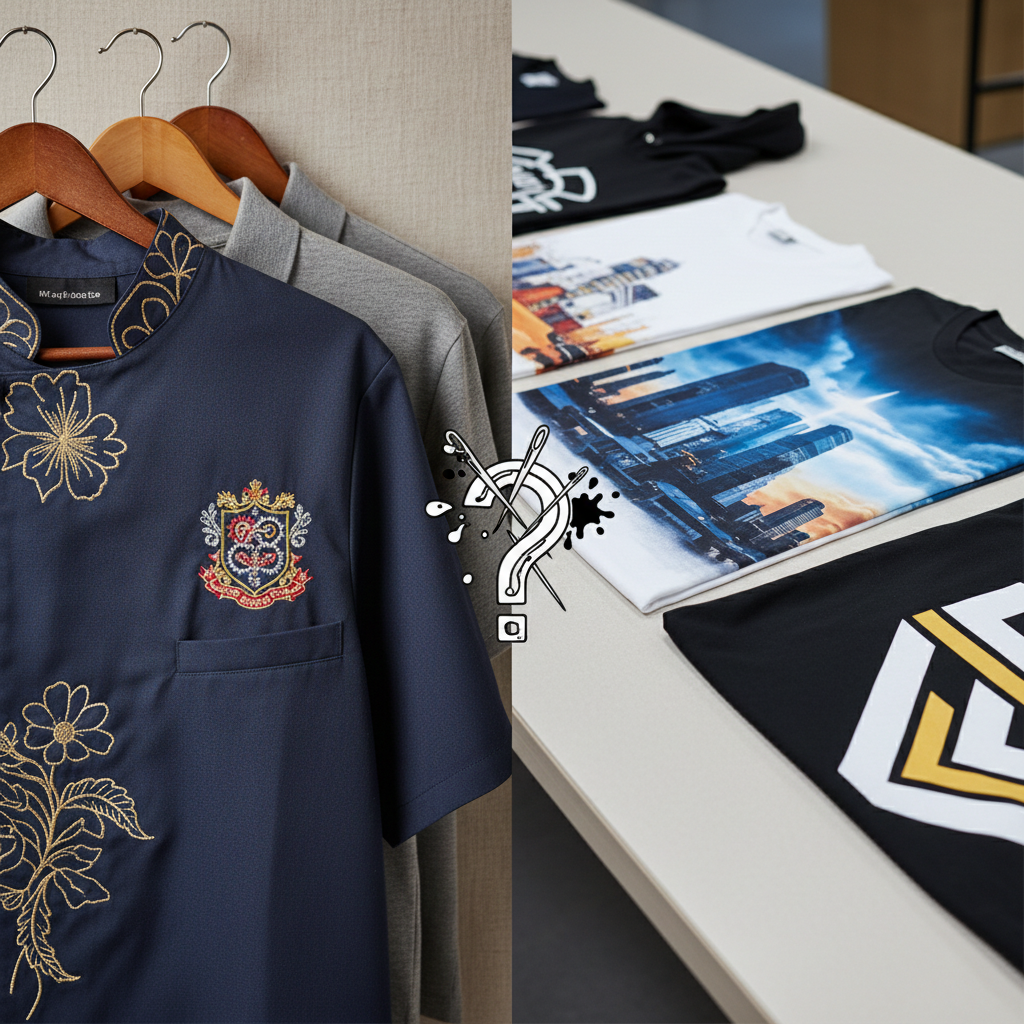
Table of Contents
- Introduction: The Visual Identity Dilemma
- The Power of Embroidery: Tradition and Prestige
- The World of Printing: Technology and Versatility
- Detailed Technical Comparison: Head-to-Head
- Cost-Benefit Analysis: Small vs. Large Businesses
- Durability and Maintenance: The Industrial Wash Test
- Sector-Specific Choice: What Works Where?
- Visual Impact and Brand Perception
- Conclusion: Which Method is Best for Your Company?
1. Introduction: The Visual Identity Dilemma
Choosing professional workwear goes far beyond simply selecting textiles and colours. When a company decides to implement corporate uniforms, it is investing in one of its most powerful communication assets: its team. However, a question often arises among purchasing managers, marketing directors, and business owners: should we opt for embroidery or printing?
This decision is not merely aesthetic. It involves complex variables such as material durability, fabric type, available budget, logo complexity, and the message the brand aims to convey. A wrong choice can result in faded logos after a few washes, fabrics damaged by excessive needle perforation, or an unsustainable unit cost for the company's reality.
In this in-depth article, we will technically dissect each method, analysing its practical applications in the context of RAG Tailor's and helping you make the most assertive decision for your business.
This article is a specialised complement to our Complete Guide to Professional Workwear and Uniforms in Portugal, where we gather the best practices and industry standards.
2. The Power of Embroidery: Tradition and Prestige
Embroidery is traditionally associated with an image of superior quality, durability, and professionalism. It is a technique that involves ornamenting fabric with threads, using needles, reproducing the logo or text directly onto the garment.
The Technical Process
Contrary to popular belief, modern embroidery is highly technological. The process begins with "punching" (digitisation), where the logo is converted into a matrix file that tells the industrial machine exactly where each stitch should be placed, the thread density, and colour changes.
Advantages of Embroidery:
- Extreme Durability: The thread used (usually high-tenacity polyester or viscose) is fade-resistant and maintains its lustre for a long time. Often, the embroidery outlasts the garment itself.
- Three-Dimensional Appearance: The texture and relief of embroidery give a sense of "weight" and quality that ink cannot replicate.
- High Temperature Resistance: Ideal for uniforms that undergo rigorous sanitisation processes.
Where Embroidery Shines
Embroidery is the preferred choice for heavier fabrics, such as polo shirts, jackets, twill aprons, and caps. On items like the Pique Knit Polo Shirt, the fabric structure perfectly supports the tension of the stitches without deforming.

View Product: Pique Knit Short Sleeve Polo Shirt 220 Gms
To learn more about the importance of elegance in specific sectors, consult our article on Corporate Uniforms: Professional Image for Businesses.
3. The World of Printing: Technology and Versatility
Printing has evolved dramatically in the last decade. In the past, it was limited to plastic transfers that cracked over time. Today, technologies like Screen Printing, DTG (Direct to Garment), and DTF (Direct to Film) offer astonishing results.
Main Printing Methods
-
Screen Printing: The oldest and most industrial method. Uses screens to transfer ink to the fabric.
- Ideal for: Large quantities and logos with few colours.
- Feel: May leave a noticeable layer of ink.
-
DTF (Direct to Film): A recent revolution. The image is printed onto a special film and thermally transferred to the fabric with an adhesive powder.
- Ideal for: Colourful logos, gradients, and small/medium print runs.
- Resistance: High elasticity, does not crack easily.
-
Sublimation: The ink chemically bonds with the fabric fibres.
- Limitation: Only works on white or very light polyester fabrics.
- Feel: Zero feel (the ink is inside the fibre).
Advantages of Printing:
- Graphic Definition: Allows reproduction of photographic details, shadows, and gradients impossible to achieve with embroidery threads.
- Comfort on Light Fabrics: On thin t-shirts or technical sports clothing, embroidery can be heavy and irritate the skin. Printing maintains the garment's lightness.
- Cost for Large Areas: Printing a large logo on the back of a vest is much more economical than embroidering the same area (which would take hours of machine time).
For everyday and promotional items, or for teams that require high mobility without the weight of embroidery, printing is superior. See the example of our Iconic T-shirt, whose smooth combed cotton surface is the perfect "canvas" for sharp prints.

View Product: Men's Iconic T-shirt
4. Detailed Technical Comparison: Head-to-Head
To help you decide, we have prepared a direct technical comparison between the two giants of customisation.
| Feature | Embroidery | Printing (Screen Printing/DTF) |
|---|---|---|
| Durability | Excellent (Many years) | Medium/High (Depends on washing) |
| Fine Detail | Limited (Texts <5mm are difficult) | Excellent (Micron details) |
| Colours | Solid colours, no true gradients | Unlimited colours, perfect gradients |
| Price (Small Qty.) | Medium/High (Fixed matrix cost) | Medium (DTF is affordable) |
| Price (Large Qty.) | Stable | Low (Screen printing is very cheap in volume) |
| Impact on Fabric | Perforating (can pucker thin fabrics) | Superficial (respects the knit) |
| Appearance | Noble, Classic, Premium | Modern, Vibrant, Versatile |
If your company operates in environments where visibility is crucial, printing can allow for fluorescent colours that embroidery rarely matches in brightness. Learn more about safety in High-Visibility Workwear for Construction and Industry.
5. Cost-Benefit Analysis: Small vs. Large Businesses
Budget is, invariably, a decisive factor. However, "cheap" can turn out to be expensive if the customisation doesn't last.
For Small Businesses and Startups
If you only need 10 to 20 units, Embroidery can have a higher initial cost due to the creation of the "matrix" (the logo program). However, once the matrix is paid for, it can be used indefinitely. For small quantities with multi-coloured logos, DTF is unbeatable in price, as it does not require opening screen printing frames for each colour.
For Large Corporations
When we talk about 500 or 1000 units, Screen Printing becomes extremely economical, with the unit cost dropping dramatically. Embroidery, being a process that depends on the physical machine time (each stitch takes time), does not lower the price as much with quantity as printing does.
Golden Rule:
- Small logo on the chest ("heart"): Embroidery (Similar cost to printing, much higher perceived value).
- Giant logo on the back: Printing (Embroidering entire backs is very expensive and makes the garment heavy/uncomfortable).
6. Durability and Maintenance: The Industrial Wash Test
This is the critical point for sectors such as Restaurant and Hospitality or Healthcare, where hygiene is non-negotiable.
Industrial Laundry and Embroidery
Polyester embroidery thread is resistant to chlorine and diluted bleaches. It can be washed at 60°C or even 90°C (depending on the base fabric) without losing colour. This makes embroidery the only viable option for chef's jackets, medical scrubs, and uniforms that require thermal sterilisation.

View Collection: Professional Clothing for Hospitality and Restaurants
Industrial Laundry and Printing
Most prints suffer at temperatures above 40°C. Screen printing cures hot and is resistant, but continuous industrial washing with aggressive chemicals will eventually cause the ink to crack. Modern DTF withstands up to 60 domestic washes well, but is not recommended for heavy industrial washes with high-temperature drying tunnels.
For the healthcare sector, where disinfection is a priority, consult our recommendations in Healthcare, Medical and Nursing Uniforms: Antibacterial Fabrics.
7. Sector-Specific Choice: What Works Where?
Our experience at RAG Tailor's allows us to map the standard preferences of the Portuguese market:
Hospitality and Restaurants (Front-of-House)
- Verdict: Embroidery.
- Reason: Conveys elegance. A receptionist or waiter with an embroidered logo inspires confidence and sophistication.
Kitchen and Food Production
- Verdict: Embroidery (small logos) or None.
- Reason: Printing can degrade with the heat from stoves and aggressive washes to remove grease.
Health and Wellness (Spas, Clinics)
- Verdict: Mixed.
- Reason: Beauty tunics require subtle embroidery (metallic thread or tone-on-tone). Paediatric nursing, however, may prefer colourful and child-friendly prints.

View Collection: Health Uniforms and Workwear
For the aesthetics sector, see specifically: Uniforms for Aesthetics, Spa, and Hair Salons: Elegance and Comfort.
Construction and Industry
- Verdict: Hybrid Printing and Embroidery.
- Reason: Printing for large back areas (High Visibility) and Embroidery on the chest for employee name identification (more resistant to rubbing from tools and protective equipment).
Education and Schools
- Verdict: Embroidery.
- Reason: School uniforms are washed almost daily. Printing would lose quality before the end of the school year. Embroidery withstands playtime and frequent washes.

View Collection: Professional Clothing for Education
8. Visual Impact and Brand Perception
The psychology behind uniforms is fascinating. The customisation method alters how the customer perceives the value of your service.
- The Relief Factor: Humans are tactile. Embroidery creates a relief that catches light differently. In face-to-face meetings or counter service, this subconscious detail communicates "investment" and "permanence." The company didn't print a disposable t-shirt; it embroidered a durable uniform.
- The Colour Factor: If your brand relies on complex gradients (e.g., tech companies, graphic design, events), embroidery can oversimplify your logo, causing it to lose its identity. In these cases, high-definition DTG printing is visually more impactful and true to the brand.
-
Location:
- Left Chest: The classic spot. Ideal for 8-10cm embroideries.
- Sleeve: Excellent for flags, secondary icons, or roles ("Manager," "Staff"). Works well with both methods.
- Back: The "billboard" of the uniform. Use printing for messages legible from a distance.
Don't forget that footwear is also part of the image; although rarely customised, it should complement the uniform's style.  View Collection: Footwear
To understand how to combine all these elements, read our Complete Guide to Workwear and Uniforms.
9. Conclusion: Which Method is Best for Your Company?
There is no absolute winner, only the right choice for the right context. To simplify, use this final checklist before ordering your uniforms from RAG Tailor's:
- Is the fabric a thick Polo or Jacket? -> Opt for Embroidery.
- Is the fabric a thin T-shirt or light waterproof material? -> Opt for Printing.
- Will the uniform be industrially washed above 60°C? -> Mandatory Embroidery.
- Does the logo have shadows, photos, or more than 12 colours? -> Mandatory Printing (DTF/DTG).
- Is the goal luxury and prestige? -> Embroidery.
- Is the goal a short promotional campaign? -> Printing.
At RAG Tailor's, we understand that every stitch and every gram of ink tell your brand's story. Whether it's through the nobility of the yarn or the vibrancy of the ink, the important thing is that your team wears the jersey with pride and comfort.
If you still have questions about sustainability in customization methods, explore our article on Sustainable Uniforms: Ecological and Recycled Fabrics.
Ready to customize your company's image? Explore our collections and contact our specialized team for dedicated technical advice.