Skechers Work: Why swap boots for safety trainers?
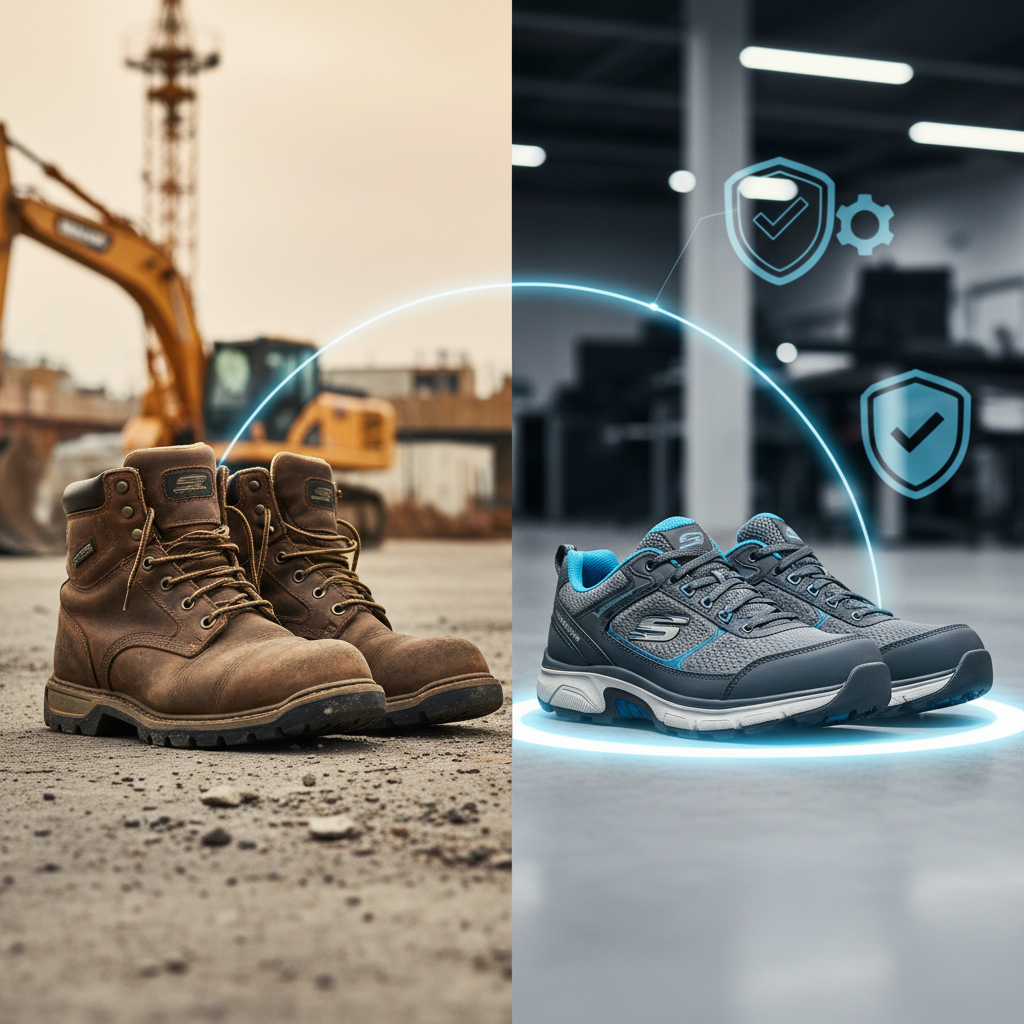
How many times have you finished a work shift feeling like your feet weighed a ton? That uncontrollable urge to take off those heavy, stiff, and hot boots as soon as you get into the car or walk through the door at home. If you're a demanding professional, a fleet manager, or a business owner concerned about your team, you know exactly what I'm talking about. For decades, we were conditioned to believe that "safety" was synonymous with "weight" and "rigidity." But the world has changed. Technology has evolved. And the question lingering in the air that could radically change your business's productivity is: does it still make sense to wear traditional boots when there are alternatives that feel like clouds but protect like armor? In this massive guide, we'll debunk myths, analyze the science, and explain why Skechers Work is leading a silent revolution in construction sites, warehouses, and hospitals across Portugal.
Table of Contents
- The Skechers Work Revolution
- The Real Battle: Boots vs. Trainers
- Certifications: What Does the Law Say?
- The Science of Comfort and Ergonomics
- Materials: Composite vs. Steel
- Applications by Sector of Activity
- The Impact on Management and ROI
- How to Choose the Right Model
- Maintenance and Durability
- Professional Testimonials
1. The Skechers Work Revolution: When Sport Meets the Construction Site
Let's be honest: until recently, safety footwear was ugly. It was a necessary evil. A hard leather "box" with a steel toe cap that crushed toes and weighed enough to anchor a small ship. Nobody wore steel-toe boots because they wanted to; they wore them because they were required by Health and Safety at Work legislation.
However, something started to change in the last decade. The boundaries between technical, sports, and casual wear began to blur. We saw this happen with fabrics, which became more breathable and elastic, and inevitably, this wave of innovation reached our feet. This is where Skechers Work comes in.
Skechers is not new to this game. Globally known for the comfort of its leisure footwear, the brand noticed a huge gap in the professional market: workers wanted Sunday comfort during their Tuesday work. It seems obvious, doesn't it? But for years, traditional PPE (Personal Protective Equipment) brands focused only on raw protection, ignoring ergonomics.
The revolution we are witnessing today is based on a simple premise: a comfortable worker is a safer and more productive worker. If your PPE trainers allow you to move faster, with less fatigue and no pain, the likelihood of making mistakes due to tiredness drastically decreases.

2. The Real Battle: Safety Boots vs. Work Trainers
This is the discussion that divides generations. The "old-guard" foreman will swear black and blue that only a high-cut boot offers real protection. The young engineer or logistics technician will argue for the agility of trainers. Who is right? Let's look at the facts, without prejudice.
The Weight Factor: The Mathematics of Fatigue
Have you heard the saying "a kilo on your feet is like five kilos on your back"? It's not just a popular saying; it's based on biomechanics studies. The energy effort to lift your foot repeatedly is significant. Traditional professional safety boots can weigh between 800g to 1.2kg (the pair, or sometimes each foot, depending on the old model). Modern safety trainers, with a composite toe cap (we'll talk about this later), can reduce that weight by 30% to 40%.
Do the math: if you take 10,000 steps a day (common in warehouses or construction), that weight difference accumulates to tons of load that your legs no longer have to lift by the end of a week. The result? Less lower back pain, fewer knee problems, and more energy at the end of the day to play with your kids or go to the gym.
Breathability and Climate
Portugal is a hot country. Working on a construction site in Alentejo in August or in a stuffy warehouse in the North with closed leather boots is a recipe for discomfort, fungi (the famous athlete's foot), and blisters. Safety trainers use technical meshes that allow air circulation, maintaining protection against impacts and punctures. The foot breathes, the temperature drops, comfort increases.
Flexibility and Driving
For those who drive forklifts, delivery vans, or trucks, pedal sensitivity is crucial. The rigid soles of traditional boots take away that sensitivity. Professional trainers are designed to flex where the foot flexes, allowing for safer and more precise driving.
3. Certifications: What Does the Law Say? (And Why Trainers Comply)
Many managers are afraid to switch to trainers because they think: "But will this pass inspection?" The short answer is: Yes, absolutely.
Footwear safety is not defined by its shape (boot or trainer), but by the standards it meets. In Europe, we are mainly governed by EN ISO 20345 (safety footwear with a toe cap resistant to 200 Joules) and EN ISO 20347 (work footwear without impact protection toe cap).
To fully understand this topic, I highly recommend reading our detailed article on Skechers Work Certifications: Guaranteed Safety, but here's an essential summary so you don't get lost in the alphabet soup:
| Category | What does it include? |
|---|---|
| SB | Basic Safety (200J Toe Cap). |
| S1 | SB + Closed heel area + Antistatic + Energy absorption in the heel. |
| S1P | Same as S1 + Puncture-resistant midsole (Ideal for warehouses and light industry). |
| S3 | Same as S1P + Water penetration resistance (WRU). |
| SRC | Maximum slip resistance level (Tested on ceramic with detergent and steel with glycerin). |
The vast majority of Skechers Work trainers you see on the market fall into the S1P or S3 categories, often with SRC and ESD (electrostatic discharge) certification. That is, visually they look like the trainers you take to the gym, but technically they are fortresses for your feet.
4. The Science of Comfort and Ergonomics
Why has Skechers gained so much traction in the professional market? The answer is two words: Memory Foam.
Memory foam insoles were a game changer. They mold to the unique shape of your foot, distributing body weight evenly. In traditional boots, you often feel pressure points – the heel rubbing, the little toe getting crushed. With Skechers technology, these pressure points are relieved.
Arch Fit: The End of Back Pain?
In addition to Memory Foam, the brand introduced the Arch Fit system. This system, developed based on 20 years of data and 120,000 foot scans, offers arch support certified by podiatrists. For those who spend 8 to 10 hours on their feet, this is not a luxury; it's a medical necessity. Proper arch support affects the alignment of the knees, hips, and consequently, the spine.
By choosing safety and protective shoes with this technology, you are not just buying footwear; you are investing in preventive health.

5. Materials: Composite Toe Cap vs. Steel
Another myth we need to debunk: "Plastic doesn't protect like steel." Wrong.
Modern safety trainers often use composite toe caps (fiberglass, carbon fiber, or ultra-resistant plastic) or aluminum alloy toe caps (Alloy Toe). Let's compare:
- Steel: It's the classic. Cheap and resistant. But it's heavy, cold in winter (conducts temperature), and beeps at metal detectors.
- Composite: Much lighter. Does not conduct electricity or temperature (feet don't get as cold). Resists the same 200 Joules of impact as steel. And the best part? If you drop something heavy, composite tends to regain its shape, while steel can dent and trap your toes.
- Aluminum (Alloy): Offers the strength of metal with half the weight of steel. Allows for a thinner trainer profile, making it aesthetically more pleasing.
Skechers strongly favors composite and aluminum toe caps, which allows for the creation of trainers that, visually, no one would say are safety footwear.
6. Applications by Sector of Activity
Not all trainers are suitable for all jobs. Specificity is key. Let's see where Skechers models shine brightest, but for a deep dive into construction and industry, be sure to read our guide on the Best Skechers Work Trainers for Construction and Industry.
Logistics and Warehouse
Here, speed is the name of the game. You need lightweight, flexible trainers with a non-slip sole for polished concrete floors that can be slippery. The ideal model is a "runner" style trainer with a light protective toe cap (S1P).
Catering and Hospitality
Kitchens are battlefields: oil, water, food scraps. The number one priority is the non-slip sole (SRC). Often, a protective toe cap is not necessary (depending on company policy), but rather water resistance and ease of cleaning. The Skechers Hands Free Slip-ins line is fantastic here – slipping them on without using your hands is a bonus for hygiene and speed.
Healthcare and Clinics
Nurses and doctors walk miles per shift. Comfort is non-negotiable. White, washable trainers with exceptional arch support are the norm. Skechers trainers for this sector focus on the EN ISO 20347 standard (Occupational).
Light Industry and Maintenance
Electricians, plumbers, HVAC technicians. These professionals need to squat, climb ladders, and enter tight spaces. Rigid boots are a nightmare in these situations. Flexible trainers with ESD (electrostatic discharge) protection are essential for those dealing with sensitive electronic components.

7. The Impact on Management and ROI (For the Bosses)
If you're a company owner or manager, you might be thinking: "That's all well and good, but these trainers are more expensive than the generic boots I've been buying for years."
That's true. The initial investment can be higher. But let's talk about ROI (Return on Investment). The real cost of footwear is not the price tag; it's the cost per use and the impact on indirect costs.
- Reduced Absenteeism: Musculoskeletal problems are one of the main causes of sick leave in Portugal. Inadequate footwear directly contributes to this. Reducing sick leave due to back pain or plantar fasciitis pays for the investment in quality trainers in an instant.
- Increased Productivity: A comfortable worker works faster and with more focus. Fatigue leads to distraction, and distraction leads to accidents.
- Talent Retention and Image: Providing branded, high-quality uniforms and footwear (like Skechers) sends a clear message to the team: "We value you." This boosts morale and pride in wearing the uniform (or, in this case, the trainers). Furthermore, your company's image to customers improves. A team equipped with modern trainers looks more professional than one with worn-out and dirty boots.
8. How to Choose the Right Model
With so many options, how do you decide? Here's a quick guide:
- Assess the Risk: Is there a risk of heavy objects falling? (Yes = Protective Toe Cap). Is there a risk of stepping on nails? (Yes = Anti-puncture midsole). Is the floor wet? (Yes = SRC Sole).
- Check the Environment: Is it indoors or outdoors? If it's outdoors and rainy, you'll need "Waterproof" or water-resistant models. If it's indoors and hot, prioritize mesh.
- Consider Foot Type: Wide feet? Skechers has the "Relaxed Fit" range (more toe room) and "Wide Fit" (wider throughout the shoe). Don't ignore this. Buying the wrong size negates all comfort benefits.
- Personal Style: Yes, it matters. If the worker likes what they see, they'll take better care of the equipment.
9. Maintenance and Durability
A common criticism of sneakers is that they "last less than leather boots." This is a half-truth. If you treat mesh sneakers like combat boots in the mud, they will wear out faster. But with basic care, their durability is excellent.
Many professional sneakers from Skechers are machine washable (always check the label!). This is a huge hygienic advantage. Furthermore, you should rotate your footwear. The ideal is to have two pairs and alternate days of use. This allows the memory foam to regain its shape and for internal moisture to dry completely, exponentially extending the shoe's life.
10. Professional Testimonials
Nothing speaks louder than the voice of those who wear them every day. Here's what we frequently hear from our customers:
"I'm an electrician and I spend my day climbing up and down ladders. I used to wear classic boots and would come home with burning feet. I switched to Skechers sneakers with an aluminum toe cap and the difference is night and day. They feel like running shoes, but with the protection I need." – Carlos M., 42 years old
"As a manager of a logistics warehouse, I introduced Skechers as an option for the team. The initial resistance ('oh, those are just play shoes') disappeared in the first week. Now no one wants anything else. I noticed that staff complain less about fatigue during double shifts." – Ana P., Operations Manager
Conclusion: The Future is Comfortable
The transition from boots to safety sneakers is not a passing fad; it's the natural evolution of workwear. It combines the best protection technology with advanced sports ergonomics.
If you're still stuck in the past, dragging heavy boots, it's time to experience the difference. Your feet (and your team) will thank you. Explore our complete range and discover why Skechers Work is conquering the working world, step by step.
Ready to make the leap? Visit our collection of Skechers Work and feel the difference on your next shift.