Skechers Work Certifications: Safety guaranteed
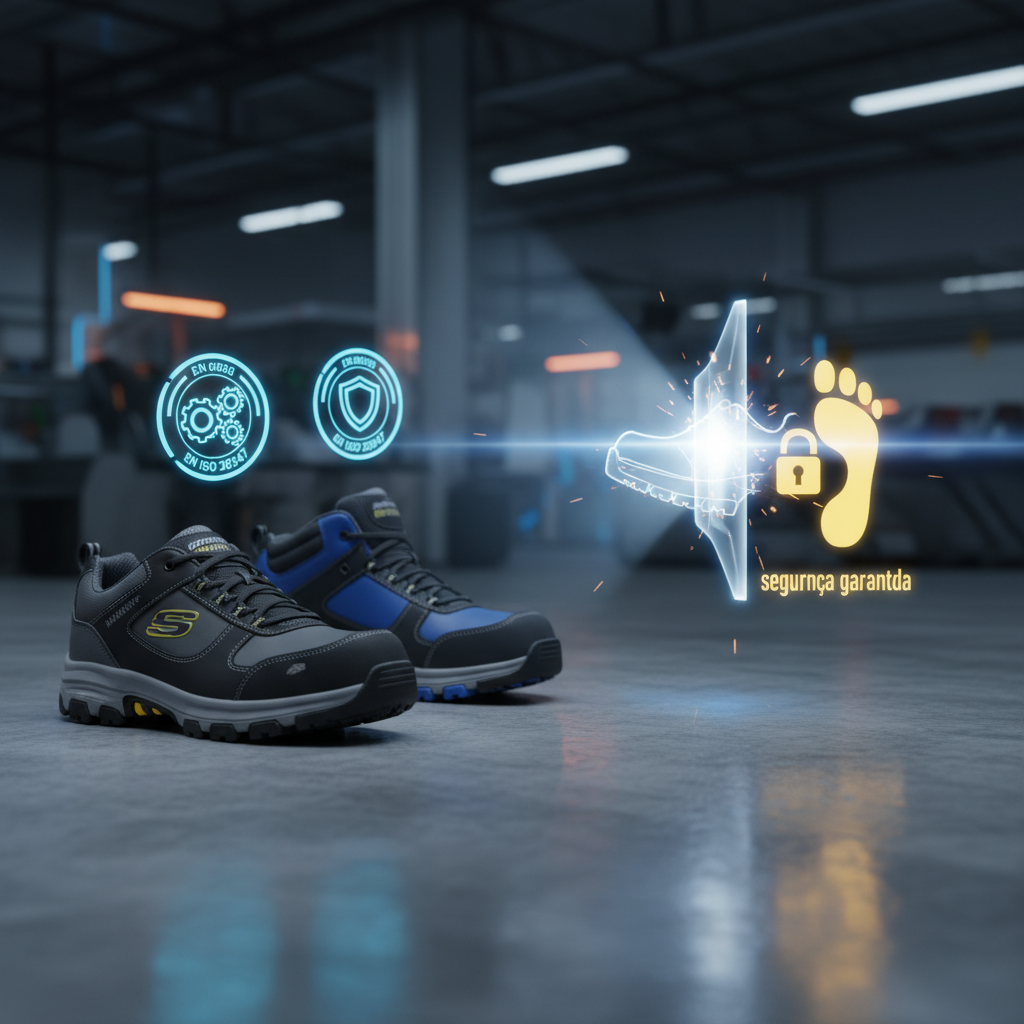
Have you ever considered that the footwear on your feet – or that your team wears daily – could be the only barrier between a productive workday and a serious accident? It's one of those inconvenient truths that we often only truly appreciate when the worst happens. In the corporate and industrial world, safety isn't just a pretty word to put in management reports; it's an absolute necessity. And when we talk about combining rigorous safety with comfort that lasts 12-hour shifts, Skechers Work sneakers emerge as undeniable protagonists. But are they really safe? What guarantees do they offer? In this technical and detailed article, we'll decode the "alphabet" of certifications and show you exactly what you're buying.
For a complete overview of this movement that is transforming professional footwear, and to understand the global context of this change, consult our pillar guide Skechers Work: Why swap boots for safety sneakers?. Now, get ready, because we're going to dive deep into the technical aspects.
Index
1. What are EN ISO 20345 and 20347 standards?
If you're a company manager, purchasing manager, or someone who takes their own safety seriously, you've probably come across a "soup of letters" and numbers on footwear labels. EN ISO 20345? S1P? SRC? What does this mean in practice? Let's demystify it, because understanding this is the foundation for making smart choices and not throwing money away.
In the European Union, professional footwear is not regulated by guesswork. There are strict standards that dictate what is considered safe. Basically, we divide the universe of professional footwear into two broad categories, and this is where many people make the first mistake.
The Critical Difference: Safety vs. Occupational
Many people confuse "work sneakers" with "safety sneakers." They are not the same thing. The distinction essentially lies in the presence (or absence) of a protective toecap against impacts.
EN ISO 20345 (Safety Footwear): This is the "heavyweight" standard. Any footwear bearing this certification MUST have a protective toecap capable of resisting an impact of 200 Joules and a compression of 15 kilonewtons. To give you an idea, 200 Joules is roughly equivalent to dropping a 20kg object from a height of one meter directly onto your toes. If you work in construction, logistical warehouses with forklifts, or any environment where heavy objects can fall, this is your standard.
EN ISO 20347 (Occupational Footwear): Here, it's a different story. This footwear is certified for professional use; it's robust, anti-slip, can be anti-static, but – and this is a huge "but" – it does not have an impact-resistant toecap. It's ideal for nurses, restaurant staff, cleaners, or hospitality workers, where the main risk is slipping or standing for many hours, and not having a brick fall on their foot.
Within the EN ISO 20345 standard, sneakers are divided into categories that define the level of additional protection. It's not enough to have a toecap; the rest of the shoe also matters. The most common categories you'll see in Skechers Work are:
- SB (Safety Basic): The basic level. Has a 200J toecap and oil-resistant sole.
- S1: Everything SB has, plus a closed heel area, energy absorption in the heel (essential for comfort), and anti-static properties.
- S1P: Same as S1, but adds a penetration-resistant midsole (nails, glass, sharp metals).
- S2: Same as S1, but with water penetration resistance and absorption (the upper repels water).
- S3: The "tank." Combines everything from S2 and adds the anti-penetration midsole and an outsole with specific treads for traction on difficult terrain.
In occupational footwear (EN ISO 20347), the categories are OB (Basic), O1, O2, etc., following a similar logic, but without the toecap.
2. Specific certifications for Skechers Work sneakers
Now that we've discussed the "gospel" of standards, how does Skechers fit into this? A few years ago, if you told a construction foreman you were going to work in sneakers, he'd laugh in your face. Today, he's probably wearing a pair of Skechers professional shoes.
Skechers didn't invent the standards, but they revolutionized how we meet them. Unlike traditional brands that started with safety and tried to add comfort (often failing), Skechers took the supreme comfort of their casual sneakers and "armored" them with safety technology.

When you examine a Skechers Work box, you'll find CE conformity seals. This guarantees that the model has been tested by independent laboratories and complies with the requirements of the EU PPE (Personal Protective Equipment) Directive.
The ESD Factor (Electrostatic Discharge)
Many models in the Skechers Work range come with ESD certification. This is crucial if you work in the electronics industry or in environments with explosion risk (ATEX zones). ESD footwear dissipates static electricity from the body to the ground in a controlled manner, protecting sensitive components and preventing sparks. Note: "Antistatic" and "ESD" are not exact synonyms; ESD is a more rigorous standard within the antistatic category.
Electrical Hazard (EH) Resistance
On the other hand, some Skechers models (common in the USA, but also available in Europe under specific standards) are classified as EH. These are designed to insulate the user from accidental electrical currents. Important warning: Typically, a shoe cannot be both ESD and EH, as one conducts electricity to the ground and the other insulates it. Choosing the wrong one can be fatal.
3. Carbon and composite material toecaps
The image of the "steel toecap" is iconic. For decades, it was the standard. But let's be frank: steel is heavy, gets cold in winter, and sets off metal detectors at airports or security zones. Skechers, true to its philosophy of innovation, has invested heavily in alternatives.
As you browse our steel-toecap footwear section, you'll see that classic options still exist, but the main highlight goes to Composite and Alloy Toe toecaps.
| Toecap Type | Main Advantages | Relative Weight |
|---|---|---|
| Steel Toe | Maximum protection against cuts, slimmer profile, affordable price. | Heavy |
| Alloy Toe | As resistant as steel but 30-50% lighter. | Medium/Light |
| Composite Toe | Non-metallic (does not beep at detectors), thermal insulation (does not freeze or heat up), light. | Light |
| Carbon Toe | The evolution of composite. Extremely light, thin, and resistant. | Very Light |
Skechers sneakers often use the designation "Composite Toe" or "Carbon Toe." The great advantage for those who walk 10,000 or 15,000 steps a day is the weight. 50 grams less on each foot may seem small, but after 8 hours, it's tons of accumulated weight that your legs didn't have to lift. This translates into less fatigue, and less fatigue means fewer accidents.
4. Anti-slip and durability tests
Slipping is, statistically, one of the most frequent causes of workplace injuries. Whether it's oil in a workshop, water in an industrial kitchen, or detergent in a hospital corridor, the floor is a silent enemy. This is where safety and protective shoes with certified soles come in.
In European standards, slip resistance is classified into three levels (although the new 2022 standard slightly changes this, SRA/SRB/SRC codes are still prevalent in the current market):
- SRA: Tested on ceramic tile floor wet with diluted detergent. This is the basic test for indoor environments such as cleaning or schools.
- SRB: Tested on smooth steel floor with glycerine (oil). Simulates oily industrial environments.
- SRC: The "gold medal." Means the footwear passed both SRA and SRB tests. It is the highest level of grip.
Skechers has developed specific outsoles, often identified as "Slip Resistant," which not only meet SRC but exceed it in many parameters. The tread design (the pattern on the sole) is fundamental here. The drainage channels of Skechers sneakers are designed to expel fluids quickly, ensuring that the rubber touches the ground and does not float on the liquid (the feared aquaplaning effect, but on your feet).

Durability and Hydrocarbon Resistance
Another crucial point is the durability of the sole in contact with chemicals. Skechers Work soles are often marked as "Oil Resistant." This means the rubber will not disintegrate, swell, or become brittle if you step on engine oil or fuels. For mechanics or aviation professionals, this is not a luxury, it is mandatory.
5. Downloads of declarations of conformity
If you manage a company with quality certification (ISO 9001) or health and safety (ISO 45001), you know that "paperwork" is your middle name. When you buy PPE shoes for your team, you need proof.
All Skechers Work models sold in the European Union are accompanied by (or have digitally available) a EU Declaration of Conformity. This document is the legal "identity card" of the shoe. It certifies that that specific batch has been tested and complies with Regulation (EU) 2016/425.
Why does this matter to you?
Imagine there's a workplace accident at your company. An employee slips and breaks a leg. The first thing the insurer and the Authority for Working Conditions (ACT) will check is whether the employee was wearing the appropriate PPE and whether that PPE complied with standards. Having the Skechers Work declaration of conformity on file is your legal safeguard that you provided certified, quality equipment.
6. Certified models for online purchase
Theory is nice, but let's get practical. Which models should you choose? The beauty of the Skechers Work range is its variety. They have successfully adapted their popular retail lines (like Arch Fit and Max Cushioning) for the professional world.
Skechers Arch Fit Work
If you suffer from foot pain, plantar fasciitis, or spend all day standing, the Arch Fit line is an engineering miracle. With arch support certified by podiatrists (yes, foot doctors), these shoes distribute body weight more evenly. In the Work version, they gain anti-slip soles and, in some models, protective toecaps, while maintaining a sporty look.
Skechers Max Cushioning Work
For those who walk miles in a warehouse or hospital. These shoes have an oversized midsole that absorbs the impact of every step. It's like walking on clouds, but clouds with SRC certification and oil resistance. They are ideal for reducing impact on joints (knees and hips).
Skechers Uno Work
Who said safety footwear has to be ugly? The Uno model is a fashion best-seller that has been adapted. It features a visible air bubble in the heel (Skech-Air), Memory Foam insole, and now comes with an anti-slip sole and, in specific versions, electrical protection. It's the number one choice for managers, architects, or floor staff who need to be presentable yet safe.
7. The Biomechanics of Safety: Why Comfort IS Safety
There's an old myth in the industry that "if it's comfortable, it doesn't protect." Skechers has come to debunk that idea. In fact, science shows us the opposite: discomfort is a safety risk.
When a worker wears rigid and uncomfortable boots, several things happen:
- Early Fatigue: The body expends more energy compensating for the discomfort and weight of the footwear. A tired worker has slower reflexes and makes poorer decisions.
- Posture Alteration: If feet hurt, we change the way we walk to alleviate the pain. This creates misalignments in the spine and knees, leading to long-term musculoskeletal injuries (which are the leading cause of sick leave in Europe).
- Distraction: Pain is a constant distraction. If you're thinking about how much your feet hurt, you're not 100% focused on the machine you're operating.
By integrating technologies like Memory Foam (viscoelastic foam that molds to the foot) and Relaxed Fit (more space in the toe area to allow for natural foot expansion throughout the day), Skechers Work shoes address the root of these problems. It's not just about complying with the ISO standard; it's about keeping the human inside the shoe functional and alert.
8. Maintenance and Durability of Certified Footwear
Investing in a good pair of PPE shoes is just the first step. To keep certifications valid in practice (and not just on paper), they need to be cared for.
The durability of work shoes dramatically depends on use and maintenance. Here are some golden rules:
- Rotation: Ideally, have two pairs and alternate them. This allows internal moisture (sweat) to dry completely and cushioning materials (EVA, Memory Foam) to recover their original shape. Dry shoes last twice as long.
- Sole Cleaning: If the anti-slip sole is covered in mud or grease, it ceases to be anti-slip. The grooves need to be clean to drain liquids. A quick brush at the end of the shift can save you from a fall the next day.
- Visual Inspection: Regularly check for sole detachment or if the steel/composite toe cap is exposed. If metal is visible, the electrical insulation has been compromised, and the shoe must be replaced.
Many people ask: "How long do Skechers Work shoes last?" The honest answer is: it depends. In an aggressive construction environment, they can last 6 to 8 months. In a clean warehouse environment, they can last 18 months or more. But remember: the cost of replacing a pair of shoes is infinitely less than the cost of sick leave.
Conclusion: The Verdict
Certifications don't lie. Skechers Work shoes are not just "pretty sneakers" with a label attached. They are serious personal protective equipment, tested and certified to the world's most demanding standards (EN ISO 20345 and 20347). They represent a paradigm shift: the idea that we can be protected without sacrificing the well-being of our feet.
Whether you're a CEO equipping a fleet of 500 workers or a self-employed professional protecting your greatest asset (your own body), the choice is clear. Swapping the heavy boots of the past for the technology of the present isn't just a matter of fashion; it's a matter of operational intelligence.
Are you ready to feel the difference? Explore our full range and find the pair that will change your workdays.